




See the news of the Department of Foreign Languages, Translation and Interpreting (DFLTI) about the studies, events, procurements and the online courses.
Renewal of the Visual Identity of the UNESCO Chair on Threats to Cultural Heritage | 
|
Posted: 02-09-2026 13:33 | Views: 1193
Translator
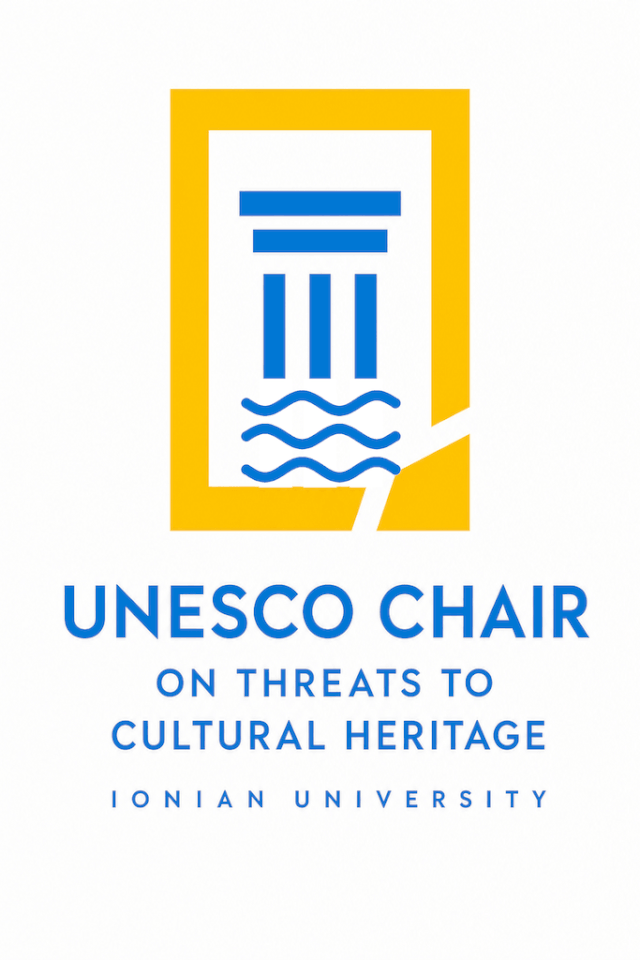
The decision to renew the logos of the UNESCO Chair on Threats to Cultural Heritage at the Ionian University reflects the Chair’s institutional development, expanding international activities, and need for a coherent, contemporary and versatile visual identity. The previous logo served the Chair during its formative period; however, its growing engagement in research, education, policy development, international cooperation and public-awareness campaigns now requires a more distinctive and adaptable identity system.
Heritage is a component of resilience, human security, and peace-building. Heritage protection sits at the crossroads between culture and security. The renewed design translates the Chair’s mission into a concise visual narrative. The classical-column motif represents historical continuity and the shared responsibility to preserve and protect humanity’s tangible cultural heritage. The fractured protective frame communicates vulnerability and threat—whether arising from armed conflict, illicit trafficking, organised crime, climate change, natural disasters, cyber risks or deliberate destruction—while simultaneously expressing vigilance, protection, security and institutional resilience. The three waves beneath the column add a further layer of meaning: they represent the fundamental role of intangible heritage and the urgency of its protection, and they parallel evoke the global mobility of cultural goods across borders and the transnational character of both heritage threats and the cooperation against them.
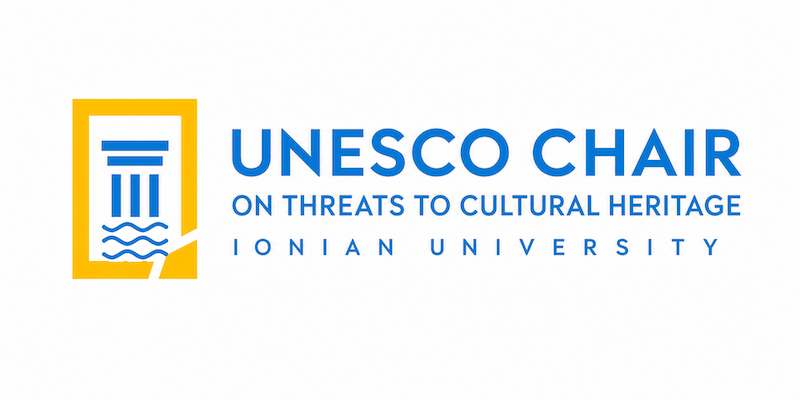
The selected colour system reinforces this symbolism. UNESCO blue establishes a clear visual relationship with UNESCO’s institutional values and international character, while the yellow frame functions as a highly visible signal of warning, attention and protective action. Charcoal-black and white versions ensure appropriate use in academic publications, official documents, exhibitions, digital media and negative-background applications. The development of horizontal, vertical, circular, icon-only, bilingual, monochrome and transparent variants provides the flexibility required by contemporary institutional communication without compromising consistency.
The renewal is also strategically important. A unified identity strengthens recognition of the Chair across its website, publications, policy papers, teaching materials, conferences, social-media channels and awareness initiatives, including campaigns against the illicit trafficking of cultural objects. Its simplified geometry improves legibility at different sizes and allows the symbol to function effectively in both print and digital environments. English and Greek versions further support the Chair’s dual national and international role.
Accordingly, the redesigned logo family should be understood not as an aesthetic change alone, but as an instrument of institutional consolidation and public engagement. It gives visible form to the Chair’s central message: cultural heritage is valuable, vulnerable and in need of organised, interdisciplinary and international protection.
The renewed identity will be implemented in a manner fully consistent with UNESCO’s applicable graphical standards. The official UNESCO/UNITWIN designation and authorized UNESCO logo will remain unaltered and, where required, will appear separately from the Chair’s complementary visual mark. Any use of UNESCO’s name, acronym or emblem will remain subject to the relevant authorization and guidance of UNESCO and the UNITWIN/UNESCO Chairs Programme. UNESCO confirms that its name, acronym and logo are protected and require prior authorization, while the UNITWIN guidelines regulate their use by established Chairs. (UNESCO Logo and Patronage; UNITWIN/UNESCO Chairs Programme Guidelines)
Back
Related News
UNESCO Chair on Threats to Cultural Heritage of the Ionian University signed the 2021 Jena Declaration
Posted: 16-07-2026 00:04 | Views: 1655

 The Jena Declaration 2021
Interview of the Director of the Hellenic Sinology Center of the Ionian University Professor Katsios Stavros to CGTN AsiaToday Program
Posted: 17-06-2026 22:15 | Views: 1518
April 23rd: World Book and Copyright Day - A celebration of the power of books
Posted: 22-04-2025 23:47 | Views: 9496
News
Secretariat
Tsirigoti Sq.
Galinos Building (1st floor)
Corfu, GR-49132
 +30 26610 87202
 dflti@ionio.gr
Hours of Operation & Public Reception Hours:
Days of Operation: Monday through Friday
Total Secretariat operating hours: 8:30 a.m.–3:30 p.m.
Public service hours: Monday, Wednesday, and Friday mornings from 10:00 a.m. to 12:00 p.m.
Galinos Building (1st floor)
Corfu, GR-49132
+30 26610 87202 dflti@ionio.grHours of Operation & Public Reception Hours:
Days of Operation: Monday through Friday
Total Secretariat operating hours: 8:30 a.m.–3:30 p.m.
Public service hours: Monday, Wednesday, and Friday mornings from 10:00 a.m. to 12:00 p.m.
 E-Class Platform
 eSecretariat
 Webmail
 Learning Material Management
 Internship Portal
 Library



